

Difference Between Hand Tools and Power Tools in Industry
Introduction
In industries such as construction, manufacturing, automotive, maintenance, and engineering, having the right tools is essential for achieving efficiency, precision, and safety. Tools used in industrial environments generally fall into two main categories: hand tools and power tools. While both serve important purposes, understanding their differences can help businesses choose the right equipment for their operations.
At Shamas, we supply a wide range of high-quality industrial tools designed to meet the demands of professionals across various sectors. In this article, we explore the key differences between hand tools and power tools and how each contributes to industrial productivity.
What Are Hand Tools?
Hand tools are manually operated tools that rely solely on human effort. They do not require electricity, batteries, or compressed air to function. These tools are commonly used for tasks that require precision, control, and flexibility.
Common Hand Tools
- Hammers
- Screwdrivers
- Pliers
- Wrenches
- Chisels
- Hand Saws
- Measuring Tapes
- Utility Knives
Benefits of Hand Tools
- Cost-effective and affordable
- Easy to transport and store
- No external power source required
- Low maintenance requirements
- Greater control for detailed work
- Suitable for quick repairs and adjustments
Limitations of Hand Tools
- Require more physical effort
- Slower for large-scale tasks
- Can cause fatigue during extended use
- Less efficient for repetitive industrial applications
What Are Power Tools?
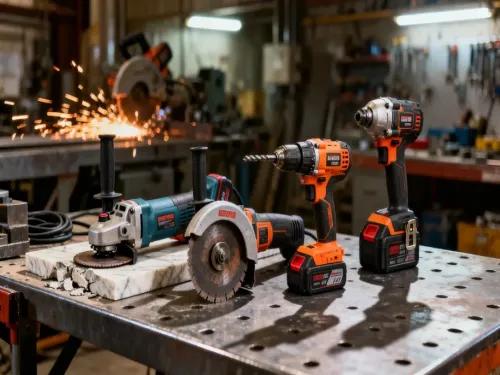
Power tools use an external power source such as electricity, rechargeable batteries, compressed air, or hydraulic systems. These tools are designed to increase productivity and reduce manual labor, making them ideal for demanding industrial environments.
Common Power Tools
- Electric Drills
- Angle Grinders
- Circular Saws
- Impact Wrenches
- Power Sanders
- Rotary Hammers
- Nail Guns
- Electric Screwdrivers
Benefits of Power Tools
- Faster task completion
- Increased productivity
- Reduced worker fatigue
- Consistent performance and accuracy
- Suitable for heavy-duty applications
- Ideal for large-scale industrial projects
Limitations of Power Tools
- Higher initial investment
- Require power sources or batteries
- Need regular maintenance
- Greater safety precautions required
- Can be heavier and noisier than hand tools
Hand Tools vs Power Tools: Key Differences
|
Feature |
Hand Tools |
Power Tools |
|
Power Source |
Manual effort |
Electricity, battery, pneumatic, or hydraulic power |
|
Speed |
Slower |
Faster |
|
Productivity |
Moderate |
High |
|
Cost |
Lower |
Higher |
|
Maintenance |
Minimal |
Regular maintenance required |
|
Portability |
Highly portable |
Depends on power source |
|
Physical Effort |
High |
Low |
|
Best For |
Precision and light-duty work |
Heavy-duty and repetitive tasks |
Industrial Applications
Hand Tools in Industry
Hand tools are commonly used for:
- Equipment maintenance
- Assembly work
- Electrical installations
- Precision adjustments
- Inspection and repair tasks
Power Tools in Industry
Power tools are widely used for:
- Construction projects
- Metal fabrication
- Woodworking
- Automotive repairs
- Manufacturing operations
- Industrial maintenance
Safety Considerations
Regardless of the type of tool being used, workplace safety should always remain a priority.
Hand Tool Safety Tips
- Inspect tools before use.
- Use the correct tool for the intended task.
- Keep tools clean and properly stored.
- Replace damaged tools immediately.
Power Tool Safety Tips
- Wear appropriate personal protective equipment (PPE).
- Follow manufacturer operating instructions.
- Inspect cables, batteries, and components regularly.
- Disconnect power before maintenance.
- Ensure proper operator training.
Which Tool Is Right for Your Business?
The choice between hand tools and power tools depends on the nature of the job.
Choose hand tools when:
- Precision and control are essential.
- Tasks are occasional or small-scale.
- Portability is important.
- Budget considerations are a priority.
Choose power tools when:
- Speed and efficiency are critical.
- Tasks are repetitive or labor-intensive.
- Large-scale projects require faster completion.
- Productivity improvements are needed.
Most industries benefit from a combination of both hand tools and power tools, ensuring flexibility, efficiency, and optimal performance across different applications.
Conclusion
Both hand tools and power tools play vital roles in modern industrial operations. Hand tools offer simplicity, precision, and affordability, while power tools provide speed, efficiency, and enhanced productivity. Understanding their differences allows businesses to select the right equipment for their specific requirements.
At Shamas, we are committed to supplying reliable industrial tools and equipment that help businesses operate safely and efficiently. Whether you need durable hand tools for precision work or powerful equipment for demanding industrial applications, our extensive product range is designed to support your success.